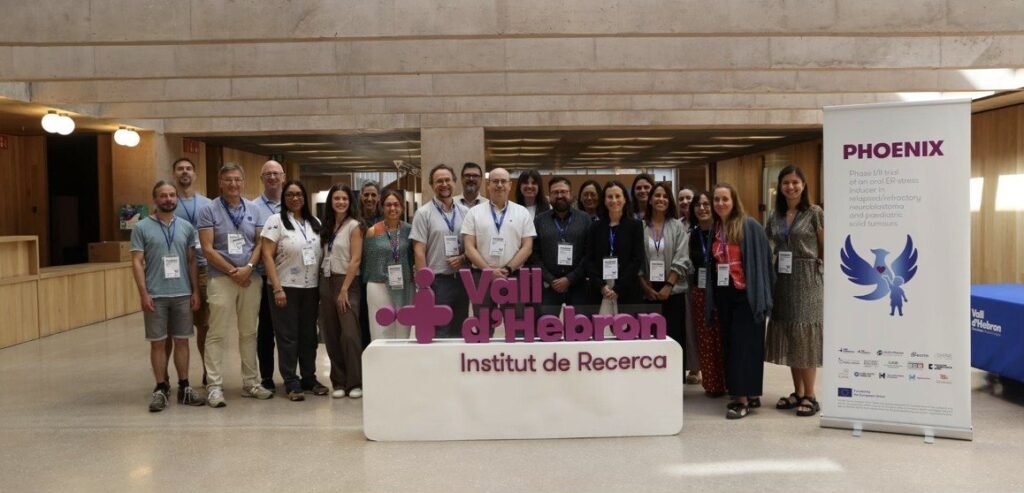
The PHOENIX project, “Phase I/II trial of an Oral ER-stress iNducer in relapsed/refractory neuroblastoma and paediatric solid tumours”, officially launched in Barcelona (Spain) on 16–17 June 2026. Coordinated by the Vall d’Hebron Research Institute (VHIR) and funded with €8.5 million by the EU Cancer Mission under Horizon Europe, PHOENIX runs over six years and brings together researchers, clinicians, patient organisations and innovation partners across Europe to develop safer and more effective treatments for children with high-risk cancers.
A new hope for children with high-risk cancer
Paediatric solid tumours such as neuroblastoma, sarcoma and certain extracranial tumours remain among the leading causes of cancer-related death in children and adolescents. Although current treatments have improved survival rates, they are often highly aggressive and can cause severe long-term side effects. Each year, more than 6,000 children are diagnosed with solid tumours in Europe, and around 1,000 of these cases are considered high-risk, with very limited or no treatment options available.
Bringing together 13 organisations from 6 European countries, PHOENIX aims to evaluate for the first time in paediatric patients the drug ibrilatazar, both as a monotherapy and in combination with current chemo- and immunotherapies, to establish safety and enhance treatment efficacy.
“Children and adolescents with cancer need therapies adapted to their biology and age, which are effective but also less toxic. With this project, we aim not only to improve survival, but also the quality of life of patients and their families.”
Dr Lucas Moreno · Head of the Paediatric Oncology and Haematology Department, Vall d’Hebron University Hospital
The drug under study, ibrilatazar (ABTL0812), has been developed by the Catalan biotechnology company AbilityPharma, a partner of the project. This will be the first time it is studied in paediatric patients, after showing excellent tolerability and signs of efficacy in adults in phase 2 trials in pancreatic, lung and endometrial cancer, as well as good results in preclinical neuroblastoma models. Unlike conventional chemotherapy, ibrilatazar is designed to target tumour cells while helping preserve healthy tissue.
A clinical trial for patients with no other therapeutic options
The PHOENIX clinical trial is expected to begin next year and will involve around 50 patients, recruited across 15 centres in 6 European countries, who currently have limited or no therapeutic alternatives available.
“This trial is the result of many years of rigorous laboratory research. Seeing this work translated into a real therapeutic opportunity for children and adolescents with cancer is both a major scientific milestone and a source of hope for families facing very limited treatment options.”
Dr Miquel Segura · Co-head of the Childhood Cancer and Blood Disorders Group at VHIR and PHOENIX Project Coordinator
Beyond the clinical trial, PHOENIX will integrate advanced personalised medicine approaches, including biomarker research and liquid biopsy technologies, to better understand how patients respond to treatment. The project will also explore social and healthcare barriers that may limit access to innovative treatments, helping promote more equitable cancer care across Europe.
A new therapeutic approach
Ibrilatazar works differently from traditional chemotherapy. Instead of damaging DNA, it activates natural cellular mechanisms that help tumour cells destroy themselves while reducing damage to healthy cells.
“This mechanism opens a new therapeutic pathway with potential applications across several tumour types, including paediatric cancers. Collaborating with VHIR in this academic trial is an opportunity to advance safer cancer therapies for children and adolescents.”
Dr Carles Domènech · CEO and co-founder of AbilityPharma
To facilitate administration in paediatric patients, a specific oral suspension formulation will be developed instead of the capsule used in adults, improving acceptability, safety and adherence. PHOENIX is part of the EU Cancer Mission cluster “Diagnosis and Treatment – Innovative clinical trials for paediatric cancer”, together with EPICA-DIPG (coordinated by the Sant Joan de Déu Research Institute) and THEODORA (coordinated by the Institut Curie).
Stay connected and follow PHOENIX on LinkedIn
To learn more about the project and how to get engaged, contact:
PHOENIX PM Coordination: Mireia Parés Oliva, mireia.pares.oliva@vhir.org
PHOENIX Communication Lead: Federica Porcu, federica@globalhealthconnector.com